Reactive vs. Preventative Electrical Maintenance: What Really Costs Your Facility?
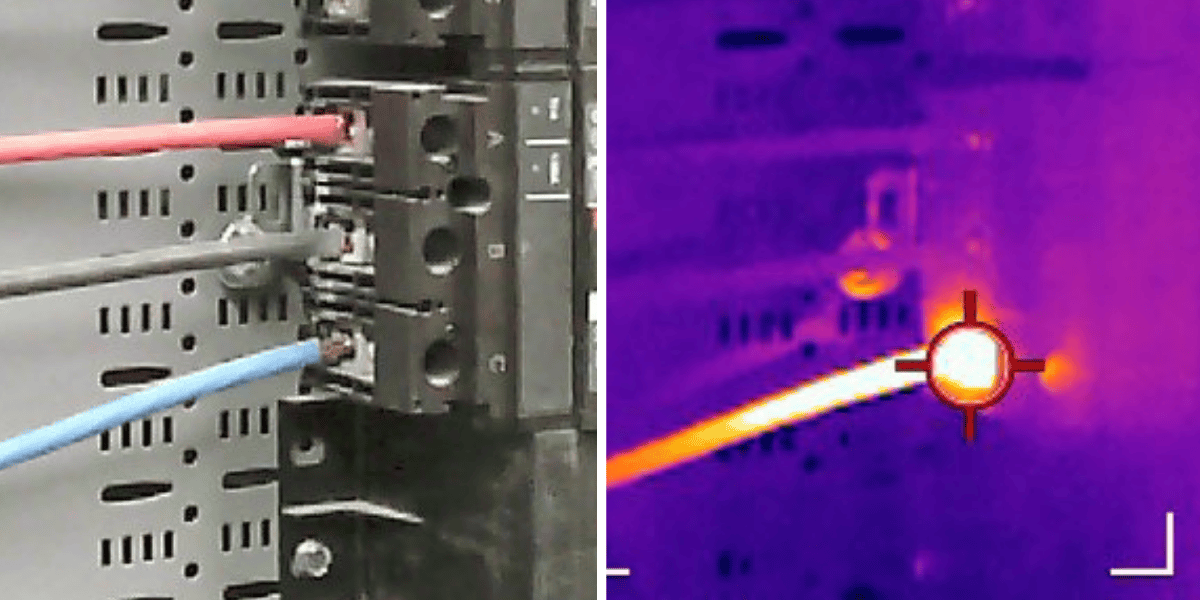
We recently completed an infrared scan at a retirement apartment building. In the scan, our electrician found a hot breaker connection that looked completely normal to the eye.
That breaker served the building’s entire seventh floor.
A failure would have caused an imbalance in the three-phase system that connects to critical equipment, including HVAC and refrigeration systems. The breaker type is also uncommon, isn’t regularly stocked by suppliers, and typically has a 5-business-day lead time from Mexico.
What might have happened with a reactive service model?
Had the breaker failed, it likely would have warranted an emergency call to reenergize the floor and protect critical equipment. If the failure occurred in the evening, that could also mean after-hours service costs, additional coordination, potential contractor unavailability, and disruption for residents and employees.
Incomplete drawings, panel directories, or service records could delay the investigation as the contractor diagnoses the problem under emergency conditions. And with the replacement breaker carrying a five-business-day lead time, the facility may also have faced higher material costs if expedited international shipping was needed for the repair.
So what actually happened with the preventative work?
Our electricians made a temporary repair, prepared an estimate, obtained the replacement, and completed the permanent repair under planned conditions.
Preventative work did not eliminate the issue or cost; the customer still had to replace the component. But what changed was the circumstances around the repair.
Look again at what happened after the scan. Because the breaker was still operating, there was time to:
- What equipment is getting serviced or added?
- What upstream and downstream equipment must be de-energized to do it safely?
- Where does the outage boundary actually start and stop?
- What else does that section feed?
Some findings will require immediate action or lead to substantial repairs. The value is that you can complete the work on a planned timeline rather than under the pressure of an unexpected failure.
Preventative electrical maintenance should match the equipment and operation
Preventative maintenance is unique to each company we work with.
For one industrial customer, Kraun services their field equipment quarterly. Their equipment returns from demanding environments that can cause physical and electrical damage. We perform insulation testing and comprehensive visual inspections before the units are returned to service.
With another customer, we annually inspect and maintain their refrigerated warehouse facility. An electrical system failure could impact crucial functions of their operation. Our inspection findings have led to a large slate of corrective work now being completed as planned.
Each program looks different because its operational risks differ.
Why an ongoing electrical service relationship still matters in an emergency
Preventative maintenance cannot eliminate every failure. New conditions can develop between visits, equipment can fail without a detectable warning, and inspections cover only the systems within the scope.
That is why facility knowledge and documentation matter.
When the contractor already knows the distribution system, service history, access requirements, and operating schedule, an urgent call does not begin from zero. Previous reports show what has been inspected, completed, or left outstanding.
Kraun’s documented maintenance process is intended to make return visits quicker and more informed. The goal is to reduce avoidable emergencies and be better prepared for the ones that still happen.
When does reactive electrical service stop being the best model?
There is no universal number of calls or annual spending threshold that determines when a facility should move to a more structured relationship.
Sometimes the change is prompted by new regulatory or insurance requirements. Other times, it happens gradually as service calls become more frequent, recurring issues emerge, or the operational consequences of downtime become harder to ignore.
The trigger may differ, but the underlying question is the same: would the facility benefit from greater continuity and planning?
That becomes especially relevant when electrical issues are recurring, downtime has meaningful operational consequences, parts are difficult to source, repairs regularly require shutdown planning, or documentation is incomplete.
The next right step away from a purely reactive service model could be a one-time assessment, a targeted service schedule, a formal preventative maintenance program, or an ongoing service agreement. Each company is different, but the goal remains: create more opportunities to identify, plan for, and address electrical work before every decision must be made under pressure.
Fewer surprises are the real return
Back at the retirement building, the breaker still needed to be replaced. The infrared scan did not eliminate that repair or tell us exactly when the connection might have failed.
But it did change the circumstances around the work.
Instead of the breaker determining the timeline, there was time to temporarily address the condition, obtain the replacement, and complete the permanent repair under planned conditions.
In other words, the outcome was boring. And that was the point.
Reactive service can still make sense when electrical issues are rare and have little operational consequence. But when an outage affects production, tenants, critical equipment, or other building operations, the invoice is only one part of what a failure can cost.
Preventative maintenance creates opportunities to identify conditions earlier, document what is happening, and make decisions while options are still available. An ongoing service relationship adds continuity when problems arise: the contractor knows the facility, previous records are available, and each visit does not have to start from scratch.
That is the practical return of moving from purely reactive electrical service toward planned maintenance: not zero failures, but fewer surprises and more control over what happens next.
Kraun can review your facility, recurring issues, critical equipment, and operating schedule to determine whether the right next step is targeted testing, planned service, or a structured maintenance program. Let’s connect! Call us at 905-684-6895, email kraun@service.ca, or use the form below to get in touch.
Frequently asked questions about preventative electrical maintenance
What is the difference between reactive and preventative electrical maintenance?
Reactive electrical maintenance addresses problems after equipment fails, trips, loses power, or otherwise requires attention.
Preventative electrical maintenance is planned work intended to identify developing conditions, document equipment condition, and address issues before they become unplanned failures, where possible.
The main difference is not that preventative maintenance eliminates repairs. It gives facilities more opportunities to investigate, budget, source materials, coordinate shutdowns, and complete corrective work under planned conditions.
Does preventative electrical maintenance prevent every electrical failure?
No. Preventative maintenance cannot guarantee uninterrupted operation or identify every future failure.
Electrical conditions can develop between inspections, some failures occur without a detectable warning, and testing only covers the equipment included within the maintenance scope.
The goal is to identify detectable conditions earlier, improve documentation, and reduce the number of electrical problems that first become known during an emergency.
What can a commercial electrical preventative maintenance program include?
The scope of a commercial electrical preventative maintenance program depends on the facility, equipment, operating conditions, and consequences of downtime.
Depending on the application, maintenance may include infrared thermal imaging, visual electrical distribution inspections, insulation testing, equipment inspections, power-quality monitoring, drawing and panel-directory updates, documentation, and prioritized corrective recommendations.
Kraun develops preventative maintenance programs around the specific equipment and operational requirements of each facility. Learn more about Kraun’s preventative maintenance services.
How often should preventative electrical maintenance be performed?
There is no single maintenance interval that applies to every commercial or industrial facility.
The appropriate frequency depends on factors such as the equipment being maintained, operating environment, usage, previous findings, manufacturer requirements, compliance or insurance requirements, and the operational consequences of a failure.
Some equipment may require frequent inspections, while other electrical systems may be reviewed annually or on another planned schedule.
How do I know if my facility needs preventative electrical maintenance?
Look beyond the cost of an individual electrical repair and consider what happens when a failure occurs unexpectedly.
Recurring electrical calls, critical equipment, difficult-to-source components, incomplete electrical records, aging infrastructure, required shutdowns, and significant consequences from downtime can all indicate that a more planned approach is worth considering.
The right starting point does not necessarily require a comprehensive maintenance program. A facility may begin with an assessment, infrared scan, targeted testing, or planned service visit.
Do I need an electrical service agreement to start preventative maintenance?
No. Preventative electrical maintenance does not necessarily require an ongoing service agreement.
A facility can begin with a one-time assessment, targeted testing, an infrared scan, or scheduled maintenance on specific equipment. Findings and service history can then help determine whether recurring maintenance or a longer-term electrical service relationship would provide additional value.